LATERAL HUMERUS
Complete lateral projection protocol of the humerus
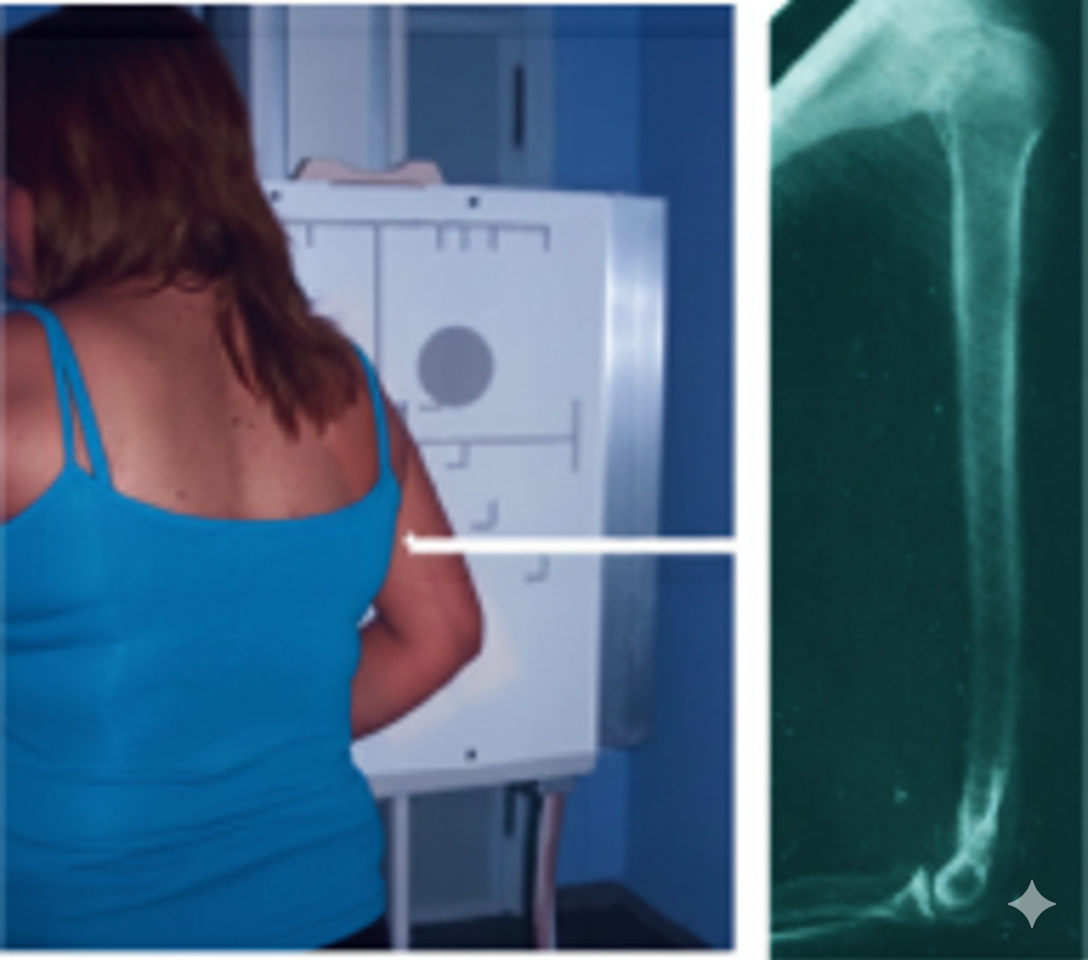
Exposure Factors
Medium exposure: Parameters optimized for lateral visualization of the humerus
Bucky Configuration
Visible Anatomical Structures
Should be clearly observed:
- Complete humerus in lateral projection
- Shoulder joint (glenohumeral) in lateral view
- Elbow joint in lateral projection
- Humeral diaphysis complete without rotation
- Proximal and distal epiphysis in true profile
- Relationship of humeral condyles
Plate Size and Orientation
Longitudinal orientation to cover complete humerus from shoulder to elbow
Patient Positioning
Critical Epicondylar Alignment
Key positioning point:
The medial and lateral humeral epicondyles must be aligned perpendicularly to the chassis plane to obtain a true lateral projection.
Central Ray Point
Direction: Horizontal and perpendicular to center of arm
Centered: To center of chassis
Target: Midpoint of humerus between shoulder and elbow
Specific Arm Position
Abduction and Flexion
Arm separated from body
Elbow flexed 90°
Palm on abdomen
Epicondylar Alignment
Epicondylar axis perpendicular to chassis
Avoid arm rotation
Maintain true lateral projection
Patient Instructions
"Do not breathe during exposure"
Maintain position without movement and apnea during radiographic exposure
Special attention in maintaining elbow flexed and palm on abdomen
Optimal Image Characteristics
True lateral view
Complete humerus in profile
Without overlap
Separated from thoracic structures
Visible joints
Shoulder and elbow lateral views
Correct alignment
Epicondyles superimposed
Common Technical Challenges
Frequent problems in lateral humerus projection:
- Arm rotation preventing true lateral projection
- Insufficient abduction causing overlap with thorax
- Incorrect elbow flexion (not 90°)
- Poor hand placement (not on abdomen)
- Poor epicondylar alignment causing oblique view
- Exclusion of joints due to poor chassis placement
Solution: Verify that epicondylar axis is perpendicular to chassis and maintain elbow flexed 90° with palm on abdomen
Adaptations for Patients with Pain
Movement Limitation
Position according to patient tolerance
Document limitations in report
Consider alternative projections if necessary
Geriatric Patient
Consider additional arm support
Position seated if standing is not possible
Adjust exposure time